-
The wheel and nylon gear need to be fixed together. This can be
achieved through several ways but for strength and ease of disassembly, (in case
it needs to be replaced) we recommend bolting it to the wheel.
-
The nylon gear needs three 5mm holes drilled.
The holes correspond to the three tapped holes in the wheel.
- Use the metal spacer as a template to drill the holes. Clamp it to the opposite side to the hub making sure it snaps in tight.
- Once drilled cut the hub as flush to the gear face as possible using a large hacksaw.
|
|
 |
|
|
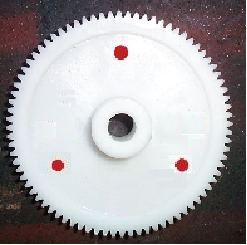
Above - mould mark on the nylon wheel. This face goes towards
the wheel/spacer |
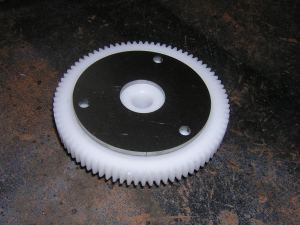
Above - nylon gear and 3mm spacer |
-
To stop the fixing bolts
distorting the nylon gear, insert the 3mm spacer disk between the wheel
and the nylon gear. The centre of the disk may need to be lightly filed
to fit onto the nylon gear. There is a mould mark on one face of the
gear (see picture above) this face goes towards the wheel. If the mark
is raised then cut flush using a chisel of stanley knife.
- The cut face of the hub (and
mould mark) face the spacer/wheel to keep spacing uniform. If the cut
face faces out it may increase wear on the oilite bushes.
Pressing on the
wheels
Before pressing on the drive wheel, slightly loosen the three
bolts on the nylon gear. This allows the gear to centre on the axle rather than
the bolts. Apply bearing fit to the inside of the wheel and the axle shaft. Only
press the driving wheel on at this stage as you need to build the motor assembly
on the axle.
|

|
CAREFUL - we use a broaching press as you get a good feel for the pressure requires and how the axle/wheel is moving.
When pressing on the wheel place the wheel on the base plate of
the press and press the axle down. Do not push the axle in one go but release
the pressure after the first few milimetres. This makes sure that the axle is
going in straight.
Some hydraulic presses can easily bend the axle or bell the end of the axle.
If too tight then put the wheels in an oven and
heat to 150 deg C and the axles in a freezer. This should be enough to
help ease them on. With this method the tailstock of a lathe should be surfice to press wheels on.
When pressing the bearings on (bearing version only) you may have to
slightly reduce the diameter of the axle end. If the bearing is too
tight it may crack the bearing.
|
Apply bearing fit to the 3 15mm bolts and bolt the Delrin gear tight to the back of the wheel.
Next Stage
|


